


HIGHLIGHTS
- The BAIC BJ30 price in Nepal is expected to be pretty premium.
- It is available in 4 different variants internationally.
- BJ30 is a hybrid off-road compact SUV with excellent mileage.
Just when it seemed no new Chinese auto brands remained to enter Nepal, another is preparing to join the race. Beijing Automotive Group is now stepping into Nepal’s rapidly growing EV market with its hybrid SUV, the BAIC BJ30. The company plans to introduce this model in Nepal within the next few months.

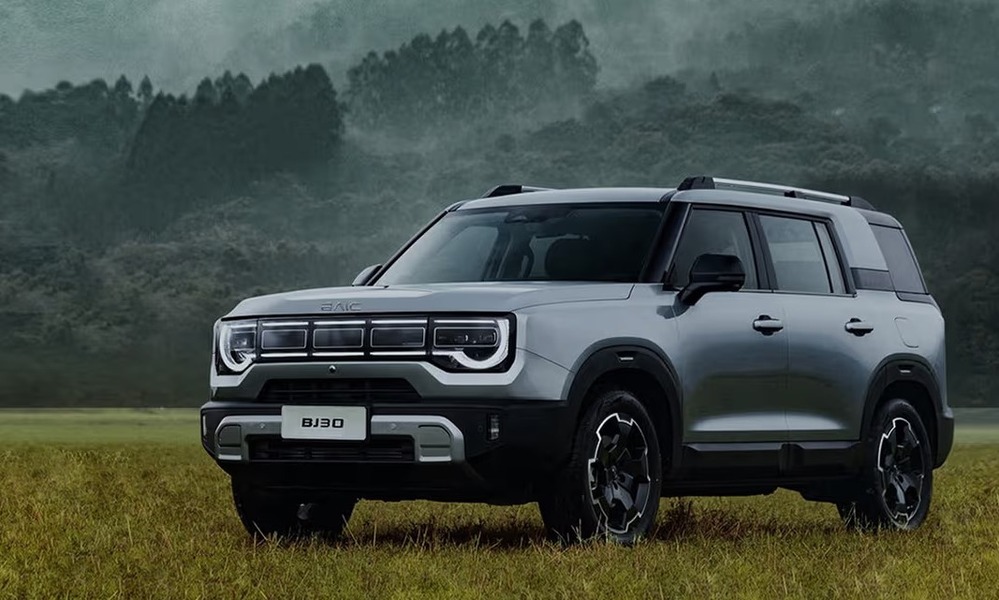
As several Chinese brands continue to establish themselves in the Nepali market, one notable name has remained absent until now. BAIC had already created buzz back in 2021, and its official entry now feels overdue. Fast forward to 2026, with Laxmi Group now handling BAIC’s distribution in Nepal, the BJ30 will be the first model to arrive, positioned as a petrol-hybrid SUV with a strong off-road focus.


BAIC’s BJ lineup traces its roots back to military applications developed after the 1960s, with a few models later adapted for civilian use. The brand revived this lineup in the 2000s with the introduction of the BJ40. From the 2010s onward, BAIC expanded its portfolio to include a more diverse and accessible range of vehicles, including new-energy models (EVs and hybrids).
What is the Price of BAIC BJ30 in Nepal?
The BAIC BJ30 price in Nepal is not disclosed as of yet. The distributor has remained tight-lipped, which suggests that pricing is still under final evaluation.
Globally, BAIC offers the BJ30 in four variants: 1.5TD 2WD LV2, 1.5TD 2WD LV3, 1.5T DHT LV4, and 1.5T DHT 4WD LV5. Among these, the latter two feature hybrid powertrains and are the most likely candidates for Nepal. However, the company might introduce only one variant initially.


Since the BJ30 targets off-road use, the 4WD hybrid variant appears to be the most suitable choice. However, that configuration would significantly increase the price. A more practical approach would involve launching the LV4 hybrid variant first, followed by the 4WD version as an optional upgrade at a later stage.
Given the current uncertainty, it makes sense to consider both hybrid variants (1.5T DHT LV4 and 1.5T DHT 4WD LV5) for now.
Here is a detailed breakdown of the BAIC BJ30’s specifications in Nepal for the upcoming model year.
BAIC BJ30 Specifications
- Performance:
- Engine:1.5L Turbocharged Hybrid Engine
- Electric Motor: Front Mounted 130 kW (LV4) / Dual-Motor 130 kW (F) & 55 kW (R) (LV5)
- Max Power: 334.5 PS (LV4) / 409 PS(LV5)
- Max Torque: 550 Nm (LV4) / 685 Nm (LV5)
- Transmission: 2-Speed Dedicated Hybrid Transmission (DHT)
- Drive Type: Front Wheel Drive (LV4) / 4-Wheel Drive (LV5)
- Total Driving Range: ~1000 km
- Dimension & Chassis:
- Dimensions: 4730 (L) x 1910 (W) x 1790 (H) mm
- Wheelbase: 2820 mm
- Kerb Weight: 1690 kg (LV4) / 1770 kg (LV5)
- Ground Clearance: 215 mm
- Suspension: McPherson Strut and Multi-Link system
- Seating Capacity: 5
- Battery & Tank
- Fuel Tank Capacity: 60-liter (LV4) / 51-liter (LV5)
- Battery Type: NMC
- Battery Capacity: N/A
- Charging Time: Not Applicable (Self-Charging)
- Wheels & Tyres
- Wheel Size: 19-inch Alloy
- Tyres: 235/60
- Tubeless Tyres: Yes
- Storage Capacity: Expandable up to 1490 liters
- Safety System: 6 Airbags, ADAS, 360 Degree Camera, TCS
BAIC BJ30 Price in Nepal: TBA
ALSO READ: BYD Sealion 7 Price in Nepal (April 2026 Updated)


BAIC BJ30 Overview
Exterior
The BAIC BJ30 adopts an “emotional hard-core” design philosophy that blends the brand’s 60-plus years of off-road heritage with a modern minimalist approach. At the same time, it preserves the nostalgic, boxy proportions typically associated with traditional off-roaders.
At the front, the BJ30 immediately draws attention with its signature five-slot grille and is integrated into a full-width LED light bar. BAIC surrounds this element with a distinctive dashed LED pattern, while neatly embedding the polygonal headlamp, which flanks the grille cluster.
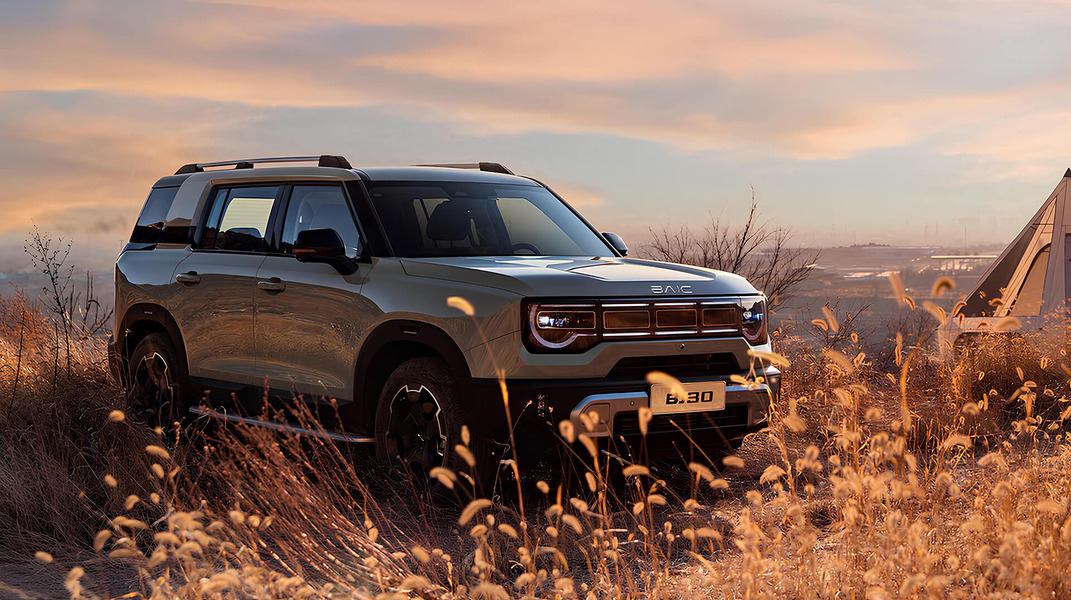
Despite its off-road intentions, the BJ30 leans more toward a refined and handsome appearance rather than an aggressively rugged one. However, BAIC has carefully added functional elements such as a skid plate, pronounced body cladding, and dedicated fog lamps to reinforce its off-road character.
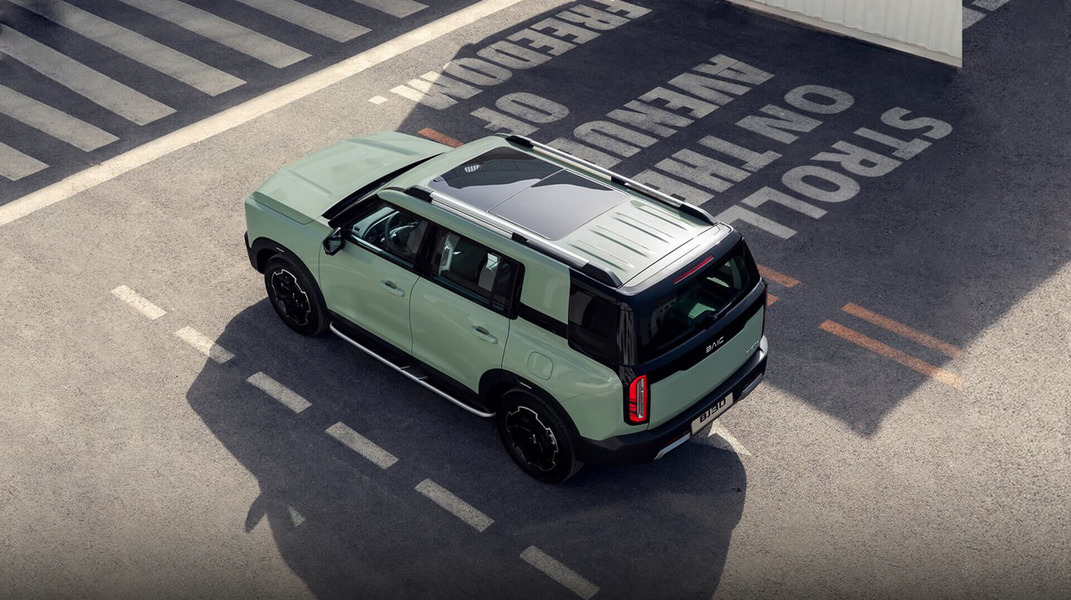
From the side, the BJ30 showcases a boxy silhouette with a high beltline that enhances its muscular stance. The floating L-shaped roof design features functional roof rails that support up to 300 kg under static conditions. For safety during driving, it is advisable to limit the load to around 80 kg. Further supporting its off-roader claim is that the SUV rides on 19-inch aluminum alloy wheels and offers a generous ground clearance of 215 mm.
At the rear, the BJ30 features vertically oriented double-D-shaped taillights that give it a distinctive identity. However, it misses a key element that many off-road enthusiasts expect. BAIC does not equip the BJ30 with a spare wheel, neither on the tailgate nor elsewhere, which may disappoint buyers who prioritize long-distance or remote terrain driving.
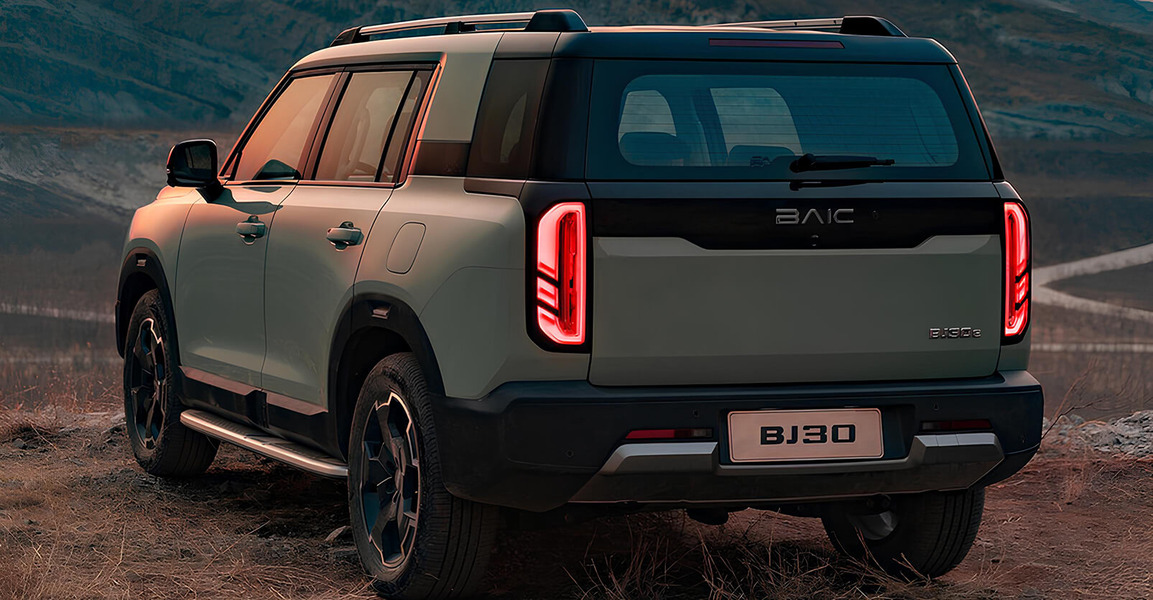
BJ30 is available in six exterior color options: Green, Blue, White, Grey, Matte Grey, and Black.
Interior
Instead of embracing a rugged, off-road-focused cabin, the BJ30 adopts the “emotional geometric” design philosophy that uses soft-touch materials throughout the cabin and positions elements thoughtfully, creating a modern environment that aligns with current minimalist design trends.
The dashboard follows a linear layout, neatly integrating the air vents and the display units. A large 14.6-inch central touchscreen takes center stage, while a 10.25-inch digital instrument cluster sits deeper behind the flat-bottom steering wheel.
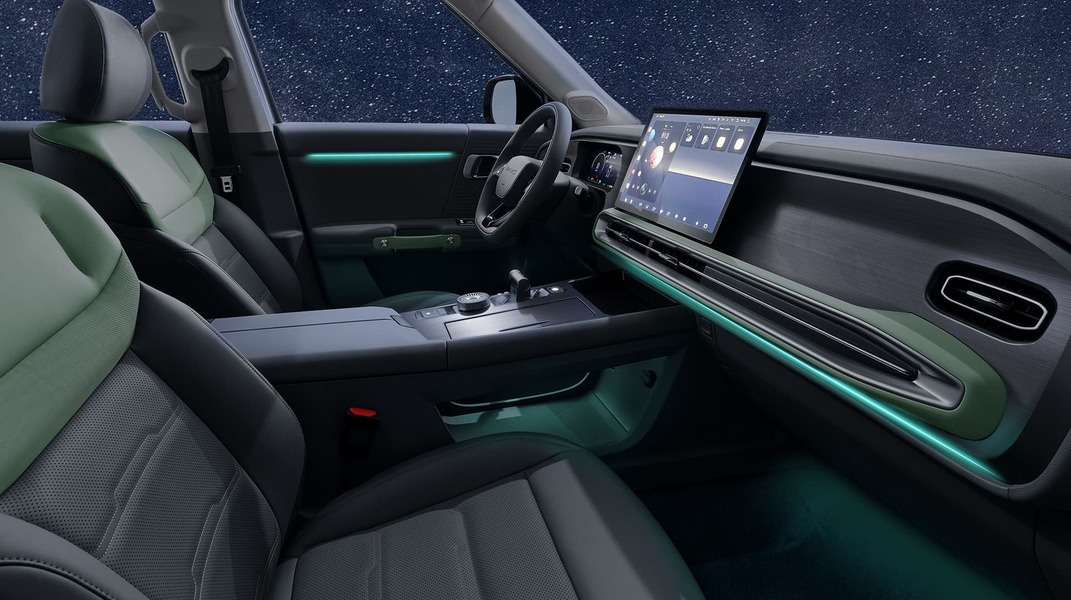
The central console brings together key controls in an intuitive manner. It features a compact stick-type drive selector instead of a conventional rotary knob. Meanwhile, the rotary dial finds a more purposeful role in the 4WD hybrid variant, where it controls terrain modes.
ALSO READ: MG IM6 Price in Nepal (April 2026 Updated)
The seats feature leatherette upholstery and offer powered adjustments for both front occupants, including a 6-way adjustment for the driver and a 4-way setup for the passenger. The front seats can fully recline to create a flat resting area across the cabin, enhancing long-distance comfort. They also include ventilation, along with a memory function for the driver’s seat.
The BJ30 further enhances the in-cabin experience with features such as a sunroof with a curtain, an 8-speaker sound system, multiple USB ports, wireless charging, and 64-color ambient lighting.
Performance
Coming to the powertrain, there are two variants based on it: 1.5T DHT LV4 or just LV4, and 1.5T DHT 4WD LV5 or just LV5.
The LV4 is a Front Wheel Drive variant of the BJ30 that is powered by a 1.5-liter Turbocharged petrol engine and a front-mounted 130 kW motor. Together, this system produces a max power of 334.5 PS and a max torque of 550 Nm. With power figures like these, the BJ30 is likely to conquer most parts.
But LV5 takes it to a higher level. It is a Four Wheel Drive variant and is powered by the same 1.5-liter Turbocharged petrol engine and the front-mounted 130 kW motor, but since it’s a 4WD, it also adds a 55 kW motor on the rear side. With that, the combined max power output becomes 409 PS, and the torque figure becomes 685 Nm. Seriously, these are some high-performance numbers.
Both LV4 and LV5 come with a 2-Speed DHT or Dedicated Hybrid Transmission, and as the name suggests, this transmission is purpose-built for hybrid vehicles.
You might be asking what about the battery? Well, we know it is a Nickel-Manganese-Cobalt (NMC) based battery, but we are unsure about the actual size of the battery used in the BJ30. Some articles suggest it is a 1.5 kWh, but until an official confirmation comes, let’s wait for that.
Unlike a plug-in hybrid vehicle, the BJ30, being a hybrid, does not need an external charger to charge its battery; instead, it runs on a self-charging mechanism and is helpful as a range extender by taking care of acceleration by powering the motor at low-running speeds or even powering the auxiliaries. But in the case of the BJ30, it’s not quite clear how the electric powertrain is tied to the overall powertrain.
The electric powertrain is definitely helping the car in maximizing its driving range since the official claim of approximately 1000 km on a full tank is surely outrageous and can not be accomplished with only the gasoline engine powering the overall running of the car. Talking about the fuel tank capacity, the LV4 has a 60-liter fuel tank while the LV5 makes do with a 51-liter tank. Based on some real-world tests, BJ30 can actually manage ~17kmpl of range, which is outstanding on its own.
Moving on, there are 4 driving modes on this car, i.e., Standard, Sports, Economy, and Snow, with an additional Launch mode for that exhilarating acceleration right at the start. But be advised, this will wear the clutch pack quickly if done regularly. The LV5 variant with its 4WD setup adds an all-terrain system by inclusion of Mud, Sand, and Wading scenarios, and also features electronic limited-slip assist for heavy off-roading.
Additional Details
The McPherson type and Multi-link type independent suspension handle the suspension duties.
The dimensions of the car are 4730 mm in length, 1910 mm in width, 1790 mm in height, and the wheelbase is 2820 mm. Ground clearance of the BJ30 is 215 mm, and the approach and departure angles stand at 24.5 degrees and 30 degrees, respectively. Again, the off-roader claim is well-justified.
It is not necessarily a heavy car as the kerb weight of the LV4 variant is 1690 kg, while the LV5 weighs 1770 kg. Between its load-bearing chassis and the hybrid engine, I will say its weight is extremely optimized.
One thing that the BJ30 is clearly hiding is the boot space. Anywhere you see the 1490-liter expanded boot space (rear seat down) is highlighted rather than the original size of the boot. By giving the benefit of the doubt to the BJ30, let’s just call it adequate for now.
BAIC BJ30 Features Highlight
Exterior:
- Polygonal LED Headlights
- Roof Rails
- 19-inch Aluminum Wheels
- Anti-Scratch Side Claddings
- Electric Tailgate
Interior:
- Leatherette Upholstery
- Driver 6-Way and Passenger 4-Way Electric Adjustment
- Front Seats Ventilation
- Fully Flat Foldable Seats
- 14.6-inch Infotainment Screen
- 10.25-inch Digital Instrument Cluster
- Dual-Zone AC
- 64-color Ambient Lighting
- Sunroof with Shade
- Wireless Charging
Safety:
- 6 Airbags
- ADAS
- Tire Pressure Monitoring System (TPMS)
- Traction Control System (TCS)
- Electronic Stability Control (ESC)
- Electronic Limited-Slip Control (Only in LV5)
ALSO READ: GWM Tank 500 Price in Nepal (April 2026 Updated)
BAIC BJ30 Price in Nepal and Availability
Coming to the price, the BAIC BJ30 price in Nepal is under the covers right now.
The distributors are not even giving a hint about how it will be priced. There is a chance that BJ30 will be launched in two variants as we discussed so far, the LV4 and LV5. The LV5 with its 4WD drive setup will naturally be pricier than the base LV4 variant. But this is based on the assumption that BJ30 will come in two options.
The distributors are preparing to bring to Nepal, with the launch scheduled after a few months. We will update this article as more information comes to light, so stay tuned for updates.
| BAIC BJ30 | Price in Nepal |
|---|---|
| LV4 | TBA |
| LV5 | TBA |
Rivals
The one rival that immediately comes to mind for the BAIC BJ30 is the GWM Tank 300. Both SUVs combine hybrid technology with serious off-road intent. Since the Tank 300 is available in a four-wheel-drive configuration in Nepal, it makes sense to compare it with the top-spec LV5 variant of the BJ30.
On the performance front, the BJ30 LV5 clearly takes the lead as it produces an impressive 409 PS of power and 685 Nm of torque, comfortably surpassing the Tank 300’s 351 PS and 648 Nm. Although the Tank 300 uses a larger 2.0-liter engine, the BJ30 benefits from a more powerful electric motor setup, which significantly boosts its combined output. In addition, the Tank 300 carries nearly 550 kgs of extra weight. This difference becomes evident in the power-to-weight ratio, where the BJ30 LV5 delivers 0.231 PS/kg compared to 0.151 PS/kg for the Tank 300, and as a result, the BJ30 feels noticeably more performance-oriented.
When it comes to off-road capability, the Tank 300 regains its ground. It offers superior approach and departure angles of 33 degrees and 34 degrees, compared to 24.5 degrees and 30 degrees in the BJ30. It also provides a slightly higher ground clearance of 224 mm, while the BJ30 stands at 215 mm. Although the difference in clearance appears minimal, the improved angles give the Tank 300 a more confident edge on challenging terrain.
The BJ30 LV5 responds strongly in terms of efficiency. It claims a total driving range of up to 1000 km from its 51-liter fuel tank. In contrast, the Tank 300 delivers around 12 kmpl, which translates to an estimated range of about 900 km with its larger 75-liter tank. The additional weight of the Tank 300 plays a role in this gap, but the BJ30 also demonstrates better overall powertrain efficiency as well.
Safety is another area where the Tank 300 makes a strong statement. It holds a 5-star ANCAP safety rating, and part of the reason for this rating is its heavier weight due to more rigid structural members. In comparison, the BJ30 has yet to receive an ANCAP or equivalent safety rating, leaving a question mark in this aspect.
Both SUVs bring hybrid technology into a segment traditionally dominated by diesel-powered off-roaders, and both deliver strong capabilities in their own ways. The final verdict will ultimately depend on pricing. The Tank 300 already commands a premium at around Rs. 1.60 Crores in Nepal. The BJ30 has the potential to disrupt this space, but its success will depend on how competitively BAIC positions it.
What do you think about the BAIC BJ30? Is it a right fit for Nepal’s auto market? Do let us know in the comments.
-
Honor X8d Launched in Nepal: Free Earbuds, But What Else?HIGHLIGHTS The Honor X8d price in Nepal starts at Rs. 39,999 (8/128GB). The phone features…

-
Honor Magic 8 Pro Buyers Can Get A Tablet For FREE (Yes, Really!)HIGHLIGHTS The Honor Magic 8 Pro price in Nepal is Rs. 1,99,999 (12/512GB). The device…
-
Honor Pad X8b Lands in Nepal with Massive 10,100mAh BatteryHIGHLIGHTS Honor Pad X8b price in Nepal starts from Rs. 29,999 (4/128GB). The tablet features…