



HIGHLIGHTS
- Qualcomm introduces the Snapdragon 8 Elite Extreme Gen 6 and Snapdragon 8 Elite Gen 6.
- Both use a 2nm process and a 5GHz Oryon CPU, while the Extreme is more powerful.
- The Extreme adds Adreno Neural Fusion, more NPU memory, and 8K@60/4K@240 video recording.
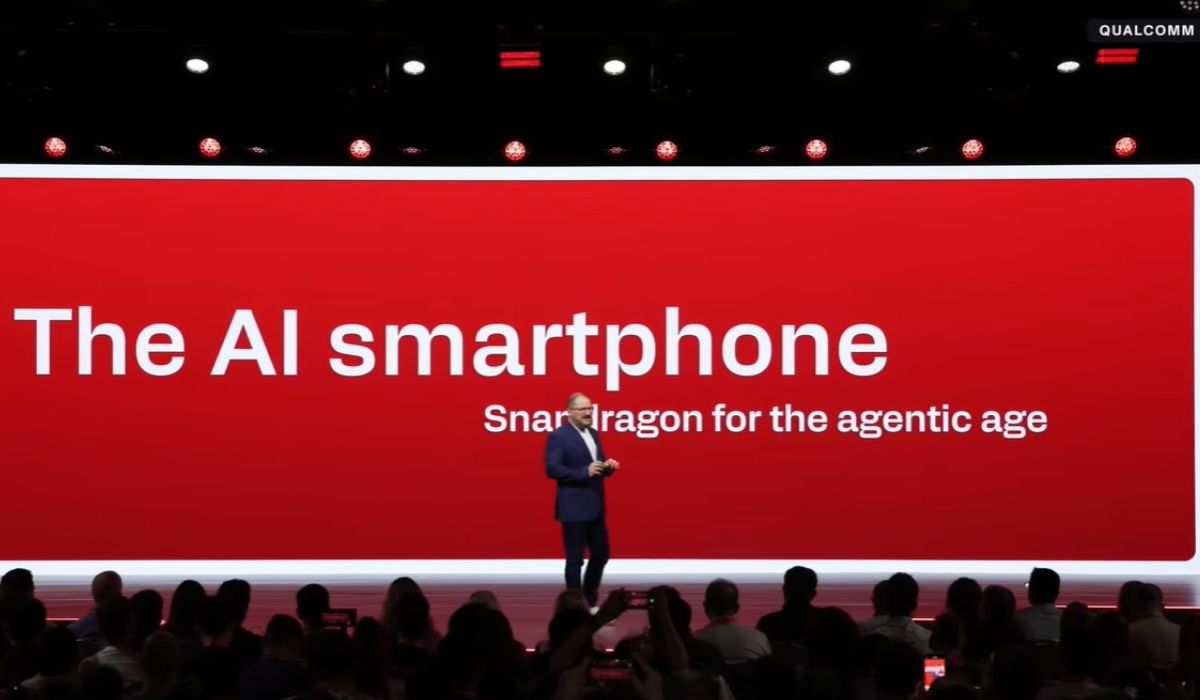
Qualcomm apparently decided that “Elite” was no longer elite enough. At Snapdragon Summit 2026, the company introduced two flagship mobile platforms: the Snapdragon 8 Elite Gen 6 and the Snapdragon 8 Elite Extreme Gen 6.

Both chips are built on a 2nm process, push Qualcomm’s custom Oryon CPU to the 5GHz mark, and are heavily designed around the industry’s current obsession: AI.
That 5GHz figure, in particular, didn’t come out of nowhere. Qualcomm has spent the last few years steadily pushing flagship smartphone CPUs closer to this mark. The Snapdragon 8 Gen 3 topped out at 3.4GHz, the first Snapdragon 8 Elite took a huge leap past 4GHz, and last year’s Snapdragon 8 Elite Gen 5 pushed that further to 4.74GHz.

Now, with the Elite Gen 6 series, Qualcomm has finally broken the 5GHz barrier, the highest clock speed it has ever offered on a smartphone chip.
So naturally, you might expect that 5GHz figure to be what makes the new Snapdragon 8 Elite Extreme Gen 6 so “Extreme”. But is it? Let’s take a closer look at what Qualcomm has actually changed this time.
Snapdragon 8 Elite Extreme Gen 6: What Exactly Is It?
First, let’s clarify what the Snapdragon 8 Elite Extreme Gen 6 actually is. We often casually call Snapdragon a “processor”, but technically, it is a System-on-Chip (SoC).
That means Qualcomm has placed several specialised processing blocks onto a single chip. So, rather than one type of processor trying to do everything, the SoC distributes different workloads to hardware designed specifically for them.
And with the Extreme Gen 6, Qualcomm appears to be leaning into that specialisation harder than before.






5Hz Is a Big Number, But!!!
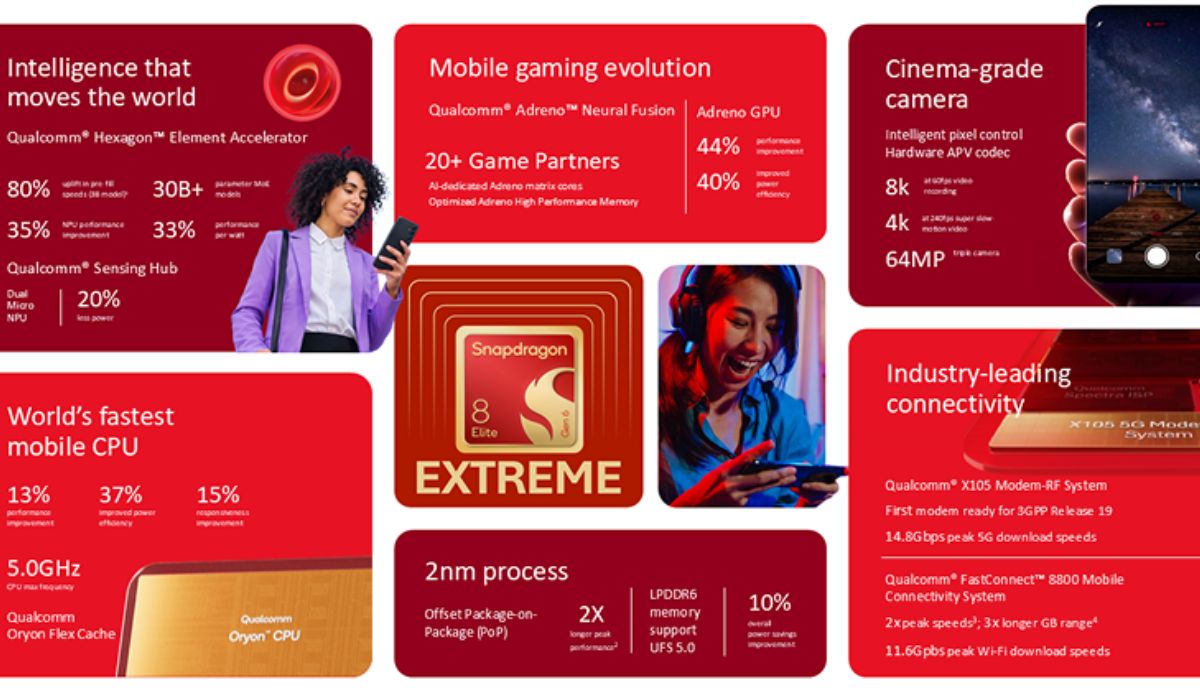
The Snapdragon 8 Elite Extreme Gen 6 uses an eight-core Oryon CPU built up of two Prime cores clocked at up to 5GHz and six Performance cores at up to 4GHz. The regular Elite Gen 6 also gets the same thing.

For comparison, the 8 Elite Gen 5 for Galaxy S26 Ultra peaked at 4.74GHz. That makes the new Gen 6 family the first smartphone CPUs to cross the 5GHz barrier. It is said to appear in upcoming flagship phones from brands like Motorola, Xiaomi, HONOR, OnePlus, OPPO, vivo, iQOO, Redmi, RedMagic, and ZTE.
But wait a minute! You must know 5GHz doesn’t automatically translate into “ridiculously faster”. Clock speed tells us how many clock cycles a processor can execute every second. At 5GHz, that is up to five billion cycles per second.
But the amount of useful work completed during each cycle also depends on the CPU architecture, and it’s IPC (Instructions Per Cycle), the number of machine-level instructions a processor can complete in a single clock cycle.
In other words, GHz is one part of performance, not performance itself. Qualcomm claims the Extreme’s CPU is 13% faster than the previous generation, while the regular Elite Gen 6 gets a slightly smaller 10% uplift. They have also claimed both deliver 37% better CPU power efficiency.
But the important question isn’t just whether the 8 Elite Extreme Gen 6 can reach 5GHz. It is how much of that performance phones can actually sustain before heat and power limitations.
That is something Qualcomm’s presentation cannot answer for us. Actual phones, cooling systems, sustained benchmarks, and battery tests will.
Qualcomm Moves Snapdragon to 2nm
Helping push those clocks higher is TSMC’s 2nm process. Both Snapdragon 8 Elite Gen 6 chips are built using TSMC’s 2nm technology, down from the previous generation’s manufacturing process.
However, Qualcomm isn’t the first company to enter the 2nm smartphone era. Samsung, Apple, and MediaTek have already introduced their 2nm chips, namely Exynos 2600, A20 Pro, and Dimensity 9600 Pro, respectively. Phones powered by the former two chips have already arrived in Nepal as well, in the form of the base Galaxy S26 and S26+, and the iPhone 18 Pro series.
16MB FlexCache
Qualcomm is also changing how its CPU cores access cache with 16MB of Oryon FlexCache. Unlike a more rigid cache setup, FlexCache gives the CPU cores access to a shared pool of fast memory, which should help workloads move between cores more smoothly.
And while 16MB sounds tiny next to 12GB or 16GB of RAM, cache has a very different job: it keeps frequently used data much closer to the CPU, where it can be accessed far faster. Because a 5GHz CPU is only useful if it isn’t constantly waiting for data.
AI Is the Bigger Upgrade on the Extreme Gen 6
Qualcomm talked about AI plenty with the Snapdragon 8 Elite Gen 5 too, so seeing “agentic AI” plastered over their launch isn’t exactly surprising. But Gen 6 does bring new hardware behind the buzzword.
Both chips get a new Hexagon Element Accelerator, designed to accelerate transformer-based AI workloads and support context windows of up to 32K tokens. They also feature an upgraded Sensing Hub with dual micro-NPUs for lightweight, always-on AI processing.
The Extreme model goes further. It gets 50% more shared NPU memory and support for Mixture-of-Experts AI models containing more than 30 billion parameters. That number sounds almost absurd for a phone, but it doesn’t activate all of it for every request. Only the relevant “experts” are used for a particular task.
Still, a chipset supporting agentic AI doesn’t automatically mean your next phone becomes a pocket Jarvis. Qualcomm is just providing the hardware. This means Google, Android manufacturers, AI developers, and apps still have to turn that hardware into something genuinely useful.
The Extreme Version Gets Better GPU Hardware
Both get an upgraded Adreno GPU, but only the Extreme version gets dedicated Adreno Matrix Cores, designed to run AI workloads directly inside the graphics pipeline. Those cores power Adreno Neural Fusion, which combines AI-powered super resolution and frame generation.
In simple terms, instead of forcing the GPU to render every pixel in every frame, AI can reconstruct a higher-resolution image and generate additional frames. It’s basically following the same path PC graphics has already taken with technologies like NVIDIA DLSS.
Qualcomm claims the Extreme GPU is 44% faster than the previous generation and 40% more power-efficient. The regular Gen 6 gets a smaller 35% performance uplift. Likewise, Extreme also comes with dedicated GPU Memory of 18MB, though Gen 6 doesn’t have it.
Generated frames can improve smoothness, but they don’t magically double the GPU’s actual rendering power, and game developers need to support Neural Fusion in the first place.
Qualcomm already lists games including Honkai: Star Rail, Diablo Immortal, and War Thunder Mobile. However, adoption will determine whether Neural Fusion is useful or it’s just another feature that looks better on a Snapdragon presentation slide.
ALSO READ: iPhone 17e Price in Nepal (October 2026 Updated)
Here’s the Weird Part!
The Extreme also gets 18MB of dedicated Adreno High Performance Memory. The regular Elite Gen 6 doesn’t. Normally, that would simply look like Qualcomm giving its more expensive chip an extra feature.
Except last year’s Snapdragon 8 Elite Gen 5 already had dedicated Adreno memory. So it isn’t only adding features above the regular flagship. It is taking hardware we already had and pushing it behind this new Extreme tier.
Cameras Might Actually Be the Biggest Upgrade
If gaming doesn’t justify the Extreme badge, video probably will. The Snapdragon 8 Elite Gen 5 supports up to 8K/30fps and 4K/120fps video.
The Extreme Gen 6 doubles both. We’re now looking at 8K video at 60fps and 4K slow motion at 240fps. That’s an enormous jump in the amount of camera data the chip can process every second.
The Extreme also gets APV professional video capture, while the regular Gen 6 doesn’t. And again, that’s slightly awkward because the Snapdragon 8 Elite Gen 5 used in the Xiaomi 17 Ultra already supported APV.
For a clearer idea, you can go through the table below and know the differences:
| Performance Hardware | Snapdragon 8 Elite Gen 6 | Snapdragon 8 Elite Extreme Gen 6 |
|---|---|---|
| Process | TSMC 2nm | TSMC 2nm |
| CPU | 2× Prime + 6× Performance | 2× Prime + 6× Performance |
| Peak Clock | 5GHz | 5GHz |
| FlexCache | 16MB | 16MB |
| CPU Gain | 10% | 13% |
| GPU Gain | 35% | 44% |
| Matrix Cores | No | Yes |
| Neural Fusion | No | Yes |
| Dedicated GPU Memory | No | 18MB |
| Large NPU Memory | Standard | 50% more |
| MoE AI | Standard support | 30B+ parameters |
| Video | 8K30/4K120 | 8K60/4K240 |
| APV | No | Yes |
ALSO READ: Samsung Mobile Price in Nepal (October 2026 Updated)
The Snapdragon 8 Elite Extreme Gen 6 is a big step for Qualcomm, but not every headline feature is something its rivals haven’t already touched.
The move to 2nm puts them where the flagship market is already heading rather than comfortably ahead of it. Samsung’s Exynos 2600, Apple’s A20 Pro, and MediaTek’s Dimensity 9600 Pro have all moved to 2nm as well. MediaTek has even beaten them, with the Dimensity 9600 Pro already supporting 8K60 and 4K240 video.
AI is becoming a similar arms race. Apple is putting neural accelerators directly into its CPU alongside a 32-core neural engine. Similarly, Samsung claims a 113% generational jump in NPU performance. And furthermore, MediaTek is already combining its CPU, GPU, NPU, and ISP around agentic AI workloads.
At the end, we can say Qualcomm’s heavy agentic-AI push isn’t happening in isolation; everyone is redesigning flagship silicon around the same idea. Though Qualcomm does have a fresh headline, it is the 5GHz Oryon CPU, which it calls the first mobile CPU to reach that mark.
So Qualcomm certainly hasn’t fallen behind, but neither is it running away from everyone else.
What are your thoughts on the Snapdragon 8 Elite Extreme Gen 6? Let us know in the comments below!
-
Xiaomi TV S Mini LED 2026 Series Launched In Nepal: Sounds Like A Steal!HIGHLIGHTS The Xiaomi TV S Mini LED 2026 Series price in Nepal starts at Rs.…

-
Apple Mac mini M6 Launched in Nepal With 4x Faster AI PerformanceHIGHLIGHTS The Apple Mac mini M6 price in Nepal starts at Rs. 174,999 (16/256GB). The…
-
Apple Watch Ultra 4 Arrives in Nepal With Better Battery LifeHIGHLIGHTS The Apple Watch Ultra 4 price in Nepal is Rs. 1,78,500. It features the…