


HIGHLIGHTS
- The Hyundai Ioniq 9 price in Nepal can be expected to be between Rs. 1.5 – 1.75 Crores.
- Ioniq 9 is a 7-seater electric SUV.
- It is likely to be available in a single variant.
Hyundai Nepal’s current electric catalogue is either uninspiring at the lower end or financially out of reach at the top, and that gap is about to widen further. Hyundai’s upcoming flagship EV, the Hyundai Ioniq 9, is expected to launch within the next couple of months, if not sooner. It will almost certainly be less accessible than anything Hyundai sells today. But it will be far more inspiring.

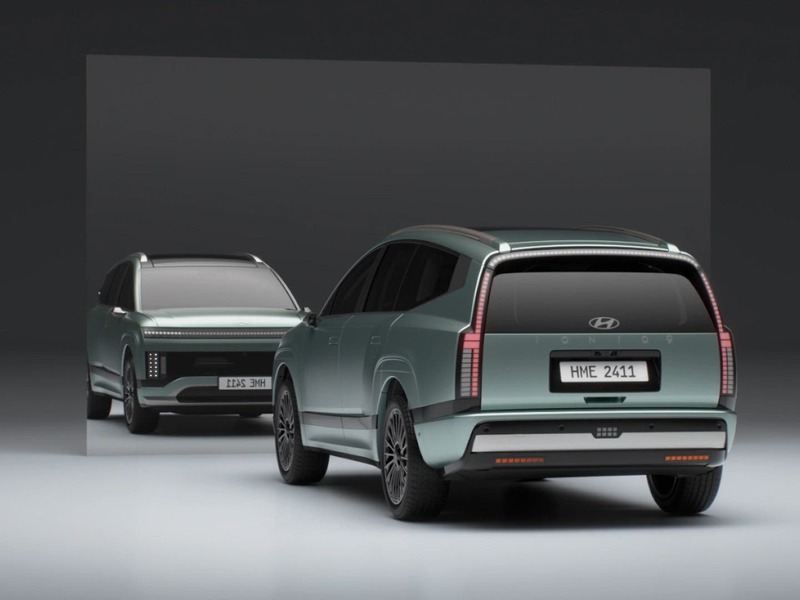
With one foot firmly planted in ICE vehicles and the other cautiously stepping into electrification, Laxmi Intercontinental Pvt. Ltd., the authorized distributor of Hyundai cars in Nepal, now appears ready to elevate its electric image with the Ioniq 9. It’s not going to be about chasing volumes or price competitiveness, rather it is about making a statement. In many ways, it signals Hyundai’s intent to be seen as a serious long-term player in Nepal’s premium EV space.

Like the Ioniq 5, the Ioniq 9 is electric from the ground up as it sits on Hyundai Motor Group’s dedicated Electric-Global Modular Platform (E-GMP). While the design philosophy is similar to that of its younger sibling, the 7-seater design, naming, and overall positioning might feel familiar to another EV.
That’s because the Ioniq 9 shares its core architecture with the Kia EV9, which is already available in the Nepali market. However, the Ioniq 9 is larger, offers more interior space, promises a more capable powertrain, and aims to be the more commanding and more premium interpretation of the platform. Fun fact: Hyundai owns a controlling stake in Kia!
From an accessibility standpoint, the Ioniq 9 will further widen Hyundai Nepal’s current EV gap. But from a brand and market perspective, that may be exactly the point. The Ioniq 9 acts as a halo product, which is meant to reshape perception rather than sales charts. It hints at what the future EV landscape in Nepal could look like if infrastructure, policy, and consumer confidence continue to mature.


By committing to bringing a full-size, high-end electric SUV like the Ioniq 9 to Nepal, Hyundai is effectively throwing down the gauntlet. It is betting that the market is ready, or at least close to ready, for EVs that prioritize scale, sophistication, and presence over affordability alone. Whether that bet pays off remains to be seen.
What is the Price of Hyundai Ioniq 9 in Nepal?
Hyundai Ioniq 9 price in Nepal is not disclosed as of yet. That said, we expect the Ioniq 9 price in Nepal to be anywhere between Rs. 1.50 Crores to Rs. 1.75 Crores.
This estimation is derived from the Ioniq 9’s global base MSRP of around $59,000–$62,000, which converts to roughly NPR 85–90 lakhs. Nepal’s EV import taxes (30% customs, 20% excise, and 13% VAT on the 160 kW motor), along with logistics costs, and Laxmi Hyundai’s dealer margins.
If Hyundai Nepal decides to cap the motor capacity (which it shouldn’t) or price it competitively (which it should), then the pricing can come down from our estimation.


Another thing to note is that the Ioniq 9 will be available in a single variant for Nepal, which is known as RWD Standard (Long Range). Other variants are the all-wheel drive option, which won’t make its way in Nepal.
Now, let’s have a look at the key specifications of the Hyundai Ioniq 9 in Nepal for 2026.
Hyundai Ioniq 9 Specifications
- Motor & Drivetrain:
- Motor: 160 kW PMSM
- Max Power: 218 PS
- Max Torque: 350 Nm
- Transmission: Single-Speed Automatic
- Drive Type: Rear Wheel Drive
- 0 to 100 km/h: 9.4 seconds
- Top Speed: 190 kmph
- Dimension & Chassis:
- Dimensions: 5060 (L) x 1980 (W) x 1790 (H) mm
- Wheelbase: 3130 mm
- Kerb Weight: 2549 kg
- Ground Clearance: 174 mm
- Suspension: McPherson Strut and Multi-Link system
- Seating Capacity: 7
- Battery & Energy
- Battery Type: NCM (Nickel-Cobalt-Manganese)
- Battery Capacity: 110.3 kWh
- Driving Range: 620 km (WLTP)
- Charging Time:
- AC Charging: 0 to 100% in around 11 hours with an 11 kW AC Charger.
- DC Charging: 10% to 80% in around 24 minutes with a 350 kW Charger
- Charging Standard: CCS Type 2
- Vehicle To Load (V2L): Yes
- Wheels & Tyres
- Wheel Size: 19-inch Alloy
- Tyres: 255/60
- Tubeless Tyres: Yes
- Storage Capacity: 338 liters expandable up to 2419 liters
- Safety System: 5-Star ANCAP/EuroNCAP, 10 Airbags, ADAS, 360 Degree Camera
Hyundai Ioniq 9 Price in Nepal: TBA
ALSO READ: Hyundai Ioniq 5 Price in Nepal (March 2026 Updated)
Hyundai Ioniq 9 Overview
Exterior
The Hyundai Ioniq 9 follows Hyundai’s “Aerosthetic” design philosophy, which is a lexical blend of aerodynamics and aesthetics. This approach traces its roots directly to the Hyundai Seven Concept, carrying forward elements like parametric pixel lighting and a lounge-inspired cabin into a production-ready, three-row electric SUV built on the E-GMP platform.
At the front, the Ioniq 9 makes a strong first impression with its full-width parametric pixel LED light bar, which is made up of more than 500 individual lighting elements. And, vertical pixel clusters on either side handle the main headlamps and DRLs functionality. Hyundai removes the traditional grille entirely and replaces it with a smooth gloss-black panel that incorporates subtle air channels for battery cooling.
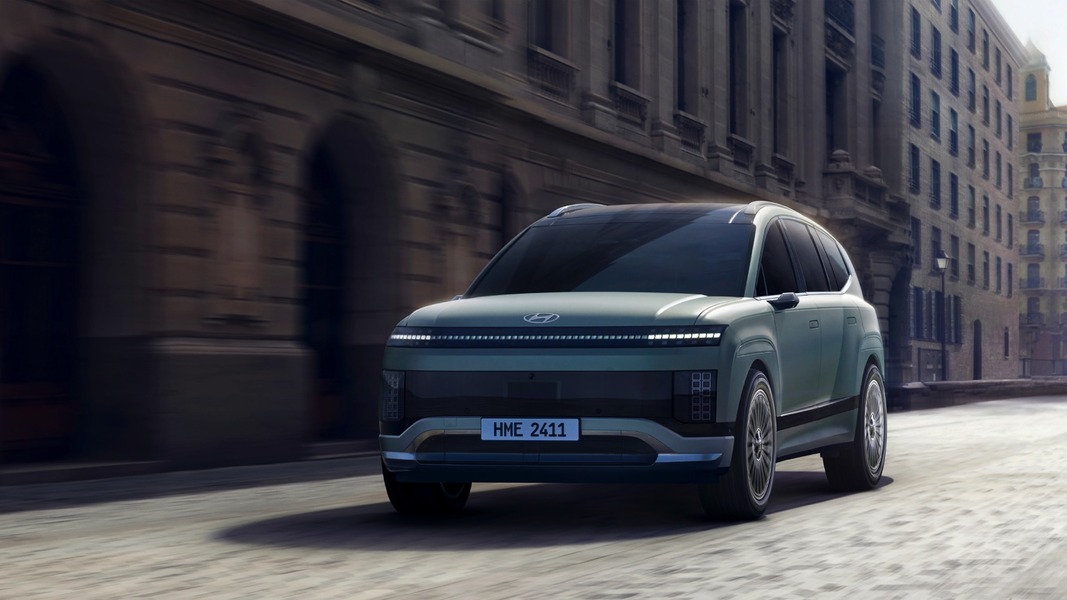
This treatment aligns well with the Aerosthetic goal of reducing drag and smoothing airflow across the nose, but it comes with a trade-off. Gloss-black surfaces tend to show scratches, dust, and swirl marks easily, and in the event of a frontal impact, repairs are unlikely to be inexpensive.
Moving on, the front bumper integrates a lower splitter with active air flaps. These flaps open and close depending on cooling demand, helping manage battery and motor temperatures while also improving aerodynamic efficiency when cooling requirements are low.
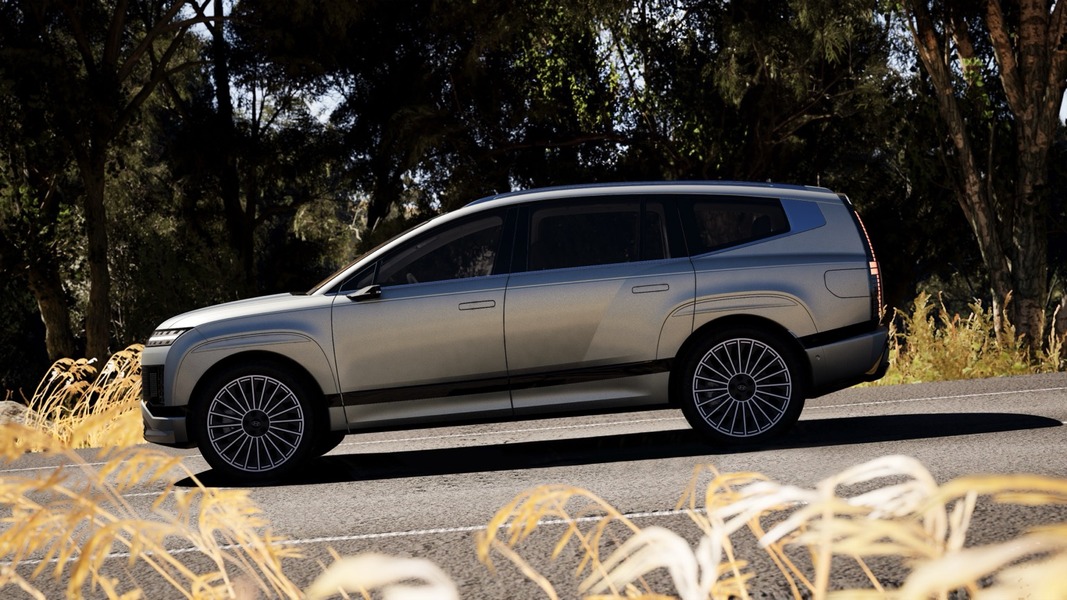
From the side, the Ioniq 9 is the most divisive. Striking does not necessarily mean conventionally attractive, and the profile definitely will not appeal to everyone. That said, there is solid engineering logic behind it. Designing a seven-seater electric SUV is a complex exercise, especially when the vehicle stretches beyond 5 meters in length. Engineers must simultaneously balance battery packaging, third-row usability, real-world driving range, and crash safety with structural rigidity. It becomes a multi-objective optimization problem where improving one area often forces compromises elsewhere.
Hyundai’s design team addressed this challenge in a fairly transparent way. Let’s understand it from the battery packaging aspect first. The E-GMP platform allows for a flat-floor battery layout, which maximizes interior volume. This shows clearly in the side profile, where the lower body remains level without visible steps or protrusions, and that flat lower section directly contributes to better cabin space and easier ingress.
Third-row usability drives the second major design decision, and this is what contributes to the polarizing side view. Hyundai clearly prioritized comfort and space over sleek proportions. The rear half of the vehicle looks long and peculiar because it needs to accommodate adults in the third row rather than treating those seats as occasional or child-only.
To put this into perspective, here is how the third-row dimensions of the Hyundai Ioniq 9 compare with those of other popular 7-seaters:
| Car | Headroom | Legroom | Shoulder Room |
|---|---|---|---|
| Hyundai Ioniq 9 | 1008 mm | 813 mm | 1398 mm |
| Kia EV9 | 1004 mm | 756 – 783 mm | 1398 mm |
| Tata Safari | 889 mm | 832 mm | – |
The Ioniq 9 stands out by offering a better balance across all usable dimensions. While the Safari edges it slightly on legroom, it falls well behind on headroom. Compared to the EV9, the Ioniq 9 offers more consistent legroom and marginally better headroom, making its third row genuinely usable for adults.
ALSO READ: Hyundai Creta Electric Price in Nepal (March 2026 Updated)
The third design priority is driving range. The gently sloping roofline, combined with a subtle boat-tail rear, helps manage airflow cleanly. Despite its size, the Ioniq 9 achieves a drag coefficient of just 0.259, which is exceptional for a vehicle in this class. This directly contributes to its ability to deliver over 500 km of real-world driving range. But it should be noted that the drag coefficient is achievable due to the digital side mirrors. The conventional ones increase the drag coefficient by 0.1, but it does not necessarily affect the driving range.
Crash safety and structural rigidity form the fourth pillar. A long wheelbase and a heavy underfloor battery require strong side structures and reinforced pillars. Thicker doors, higher shoulder lines, and broader pillars may have added visual bulk, but they also help the vehicle meet global safety standards like the ANCAP and Euro NCAP and protect occupants across all three rows.
With that all said, one attracting element must be addressed, i.e., the wheels. The Nepal-bound variant will be riding on 19-inch pretty-looking multi-spoke alloy wheels, while higher international trims offer 20-inch and 21-inch options.
At the rear, Hyundai continues the pixel theme with a full arc of lighting that stretches from the bumper up toward the roof. The U-shaped taillight signature looks distinctive at night and features dynamic lighting for braking and signaling. In daylight, however, the rear can appear slab-sided and lacks sculpted depth. One practical highlight is the height-adjustable powered tailgate, which allows users to set an opening height suitable for low ceilings or tight parking spaces.
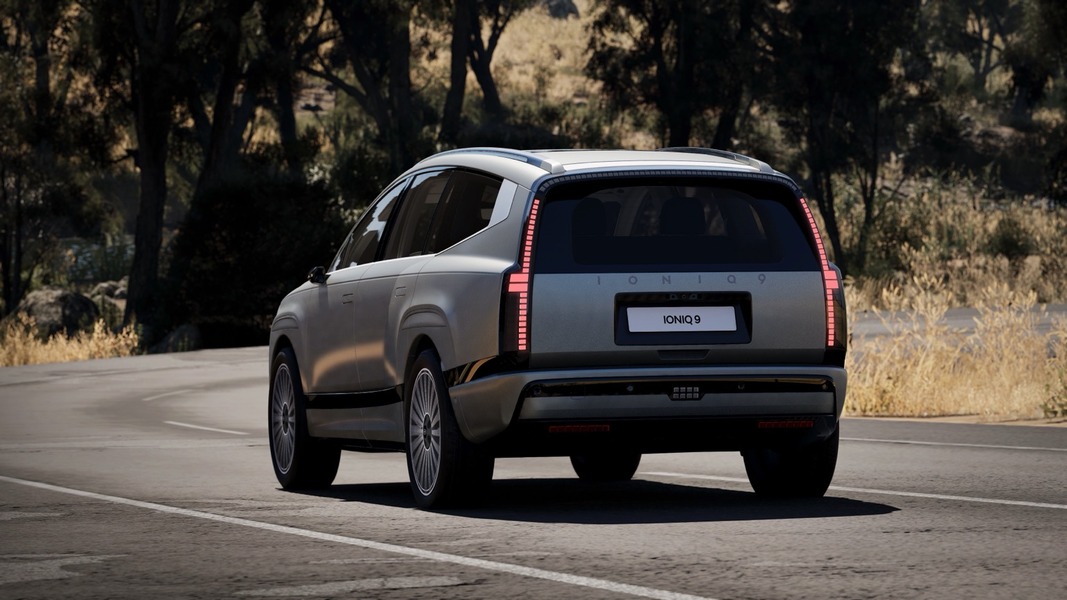
All in all, the exterior design of the Ioniq 9 clearly explains itself once you understand the priorities behind it. Hyundai chose efficiency, space, and usability, and the result leans closer to a premium electric people mover than a traditional SUV, and that will divide opinion.
Some buyers will appreciate the aerodynamic efficiency, interior space, and the fact that it stands out in a crowded EV market. Others may find it too van-like in silhouette, and it may not win any beauty contests, but as a thoughtfully engineered large electric SUV, the Ioniq 9’s case is defensible.
Interior
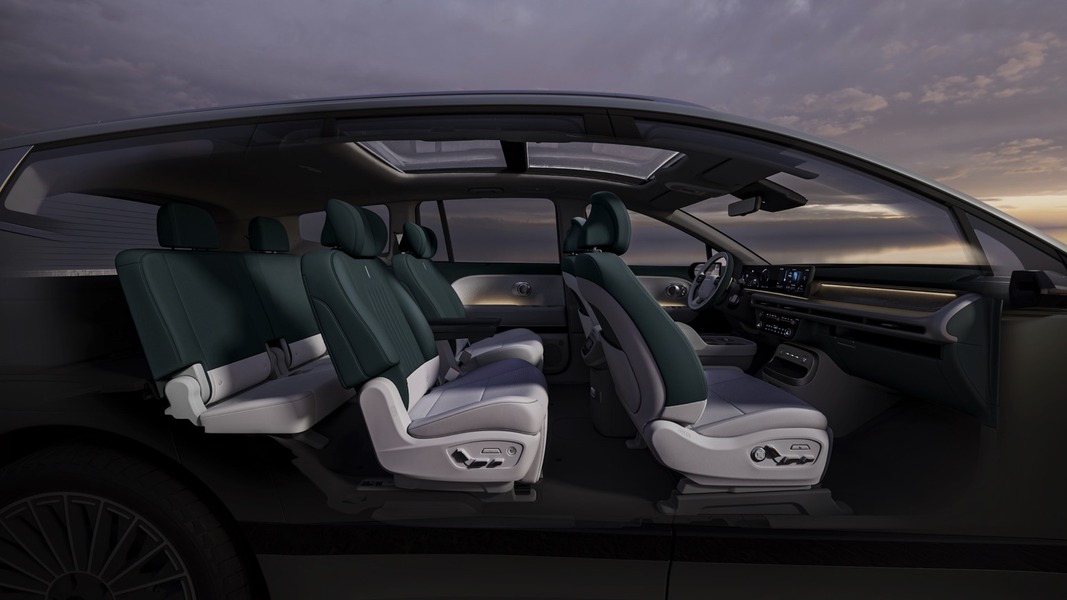
Now on to the cabin space, or you might call it a lounge, it is a three-row layout seating 6 and a maximum of 7 with a “library-quiet” ambiance achieved through multi-layer sound insulation and active road noise cancellation. All around the touch points and rest areas you’d find a good wrapping of soft touch materials, which gives the feeling of premiumness.
The seats come in a sort of dual-tone finish and are wrapped with a H-Tex faux leather. And the seats come with varied functionalities. The driver’s seat features an exclusive massage function (called Ergo Motion for massage/fatigue reduction), while both front seats come with 8-way electrically adjustability, built-in leg rests with recline function, ventilation, and heating.
The second row seats, however, feature a manual lever for position adjustment, but it does feature heating, ventilation, and separate climate control apart from the front one, which can be adjusted through the dedicated control panel at the console pillar.
The third row seats, however, do not feature any of those features. But as we discussed before, they are spacious enough to sit three full adults, and that’s how you make a 7-seater configuration car.
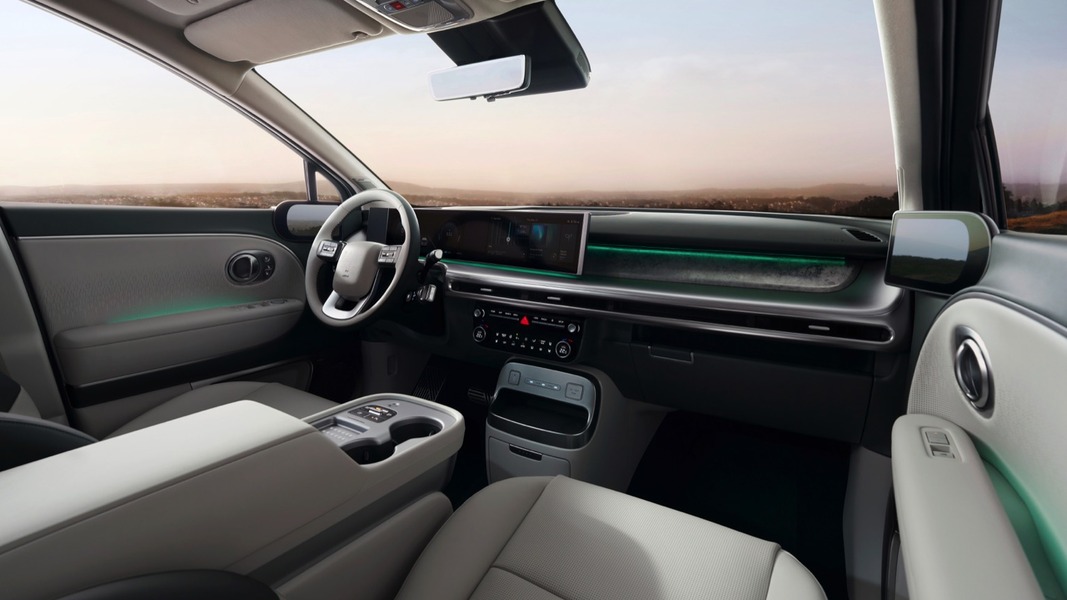
At the front of the driver sits dual 12.3-inch screens serving as infotainment and instrument cluster. Also available is the heads-up display if you don’t wanna go into the busy instrumentation. The steering wheel features power adjustability for height and positions, and yes, the steering wheel does feature mounted controls.
In fact, there are some handy controls all over the dashboard for heating, ventilation, air conditioning, and more, and it is a welcoming feature on any day. Storage is another strong suit of this car as you’d find plenty of deep storage spaces on the glove box, center console, glove box and drawers.
Other amenities include 100W charging ports, a sunroof, a 14-speaker Bose audio system, a wireless charging pad on both first and second rows, automatic climate control, etc.
Performance
Since we know that the RWD Standard (Long Range) model is heading for Nepal, we will just focus on that one for this performance part.
For this variant, Ioniq 9 is powered by a 160 kW Permanent Magnet Synchronous Motor, which generates a max power of 218 PS and a max torque of 350 Nm. Obviously, it has not broken any performance records since it has a 0 to 100 kmph sprint time of 9.4 seconds and a top speed of around 190 kmph. But as a family hauling EV weighing more than 2.5 tons (2549 kg), I’d say that is good enough. The rear-wheel drive setup also helps!
A significant portion of that weight comes from its massive 110.3 kWh battery pack. Based on the Nickel-Cobalt-Manganese (NCM) chemistry, it supports a WLTP range of 620 km while the EPA estimates it to be around 540 km. So, a real range of over 500 km is very much achievable.
The Ioniq 9’s platform is an 800V architecture, so naturally it supports extremely high levels of DC charging. Hyundai says that the Ioniq 9 supports up to 350 kW of DC charging, but it will likely average around 200 kW. But even if that is the case, the massive battery pack can be charged from 10% to 80% under 30 minutes. Charging it at home or a wall charger of 11 kW will, however, take around 11 hours of time.
Additional Details
McPherson Strut and Multi-Link system handles the suspension duties with a focus on plush comfort, featuring gas-pressurized dampers and a self-leveling rear setup to maintain stability under loads.
The dimensions are 5060 mm in length, 1980 mm in width, and1790 mm in height. Ioniq 9 stands on an astounding wheelbase of 3130 mm.
Ground clearance of the Ioniq 9 is 174 mm. But considering the soft suspension setup and the amount of load it will haul on a regular basis, the laden ground clearance will likely dip significantly. Hopefully, Hyundai Nepal will do something about that.
The storage space includes an 88-liter frunk space and 338 liters of boot space. Since it is a 7-seater, the space can be expanded up to 908 liters if you fold the 3rd row seats, and further up to a massive 2419 liters if both the 2nd and 3rd row seats are folded down.
Hyundai Ioniq 9 Features List
Exterior:
- Parametric Pixel LED DRL & Positioning Lamps
- Small Cube LED Projection Headlamps
- 19-inch Alloy Wheels
- Windscreen Auto Defog and Heated Rear Window
- Digital Side Mirrors
- Panoramic Sunroof
- Power Tailgate (height adjustable)
- Boat-tail Inspired Design
Interior:
- Panoramic Curved Display (12.3″ cluster + 12.3″ touchscreen)
- Automatic Climate Control with Independent Automatic Temperature Control (2nd-row)
- Heated 1st and 2nd-row Seats
- Powered 3rd-row Seats (folding/reclining)
- Full-flat Folding Seats (2nd & 3rd row)
- 1st and 2nd Row Wireless Charging Pad
- Digital Center Mirror
- Head-up Display
- Bose Premium Sound System (14 speakers)
- 100W USB-C ports (all rows)
- Vehicle-to-Load (V2L) Indoor & Outdoor
Safety:
- 5-Star ANCAP and Euro NCAP Rating
- 10 Airbags
- ADAS Suite
- Electronic Stability Control with Traction Control
- Hill Assist
- Tire Pressure Monitoring System
- 360 Degree Camera
- Cruise Control
ALSO READ: Deepal E07 Transformer X Price in Nepal (March 2026 Updated)
Hyundai Ioniq 9 Price in Nepal and Availability
When it comes to pricing, the Hyundai Ioniq 9 price in Nepal is expected to land somewhere between Rs. 1,50,00,000 and Rs. 1,75,00,000.
And this estimate feels realistic once you factor in its 7-seat layout, large battery pack, and the kind of premium positioning Hyundai usually reserves for its global flagship EVs. Also, given that the Ioniq 5 already retails well above the 1-crore mark, it would hardly be a shock if Hyundai pushes the Ioniq 9 straight into the premium bracket.
But, if you are specifically looking for a 7-seater EV that minimizes range anxiety, comfortably handles family space requirements, and offers a more refined long-term ownership experience, the Ioniq 9 is shaping up to be a serious contender.
The Ioniq 9 is expected to launch within the next couple of months, and this launch could signal Hyundai’s one EV launch a year intent, especially since the Creta Electric entered the market in March 2025. We will update this article as more concrete details on pricing, variants, and specifications emerge.
| Hyundai Ioniq 9 | Price in Nepal | Expected Price in Nepal |
|---|---|---|
| Hyundai Ioniq 9 | TBA | Rs. 1.50 Crores – Rs. 1.75 Crores |
Rivals
When it comes to rivalry, the comparison almost makes itself. The Kia EV9 stands as Kia’s seven-seater flagship EV for Kia Nepal, while the Hyundai Ioniq 9 plays the same role for Hyundai Nepal. Both are Korean-made, sit on the same electric platform, both sit at the top of their respective brand lineups in Nepal, and both target buyers looking for a large, premium electric family SUV.
In terms of outright performance figures, they are basically the same. Both deliver 218 PS of max power and 350 Nm of torque. Interestingly, even though the EV9 is lighter and visually appears more athletic, the Ioniq 9 manages to keep pace. Its more aerodynamic shape compensates for the added size and weight, resulting in similar real-world acceleration.
The biggest divergence comes with the battery and its real-world implications. The Ioniq 9’s 110 kWh battery pack clearly overshadows the 76 kWh unit in the EV9. In practical driving conditions, it translates to the Ioniq 9 comfortably pushing beyond the 500 km mark, while the EV9 tends to settle in the 400 km – 450 km range bracket.
Size is another area where Hyundai takes a clear lead. The Ioniq 9 feels slightly more expansive, especially when you consider passenger space and overall road presence. If interior volume and a sense of airiness matter to you, the Ioniq 9 simply feels like the more accommodating vehicle.
That said, the EV9 fights back strongly in the design department. Its sharp, polygonal design language gives it a more upright and immediately acceptable look as compared to the Ioniq 9. Balance again tips back in Hyundai’s favor is inside the cabin. The Ioniq 9 offers a stronger overall package in terms of convenience features, infotainment, and interior tech integration.
But the price factor is yet to be considered. The Kia EV9 price in Nepal is approximately 1.80 Crores, and our maximum estimation for the Ioniq 9 is 1.75 Crores. Then again, the official pricing of the Ioniq 9 has to wait, and we do expect a surprise from Hyundai Nepal. If pricing is done right, Ioniq 9 might just be the new favorite premium 7-seater EV of Nepal.
What do you think about the Hyundai Ioniq 9? Will it be able to win the niche seven-seater EV market? Drop your thoughts in the comments below.
-
Ather Rizta Gets More Affordable in Nepal: Rizta S Cuts Price, But Also FeaturesHIGHLIGHTS Ather Rizta price in Nepal starts at Rs. 2.95 Lakhs and goes up to…

-
Samsung Galaxy A37 Headed to Nepal: What Has Changed Really?HIGHLIGHTS The Samsung Galaxy A37 price in Nepal could start at Rs. 58,999 (8/128GB). The…
-
Honor Magic 8 Pro Confirmed to Launch in Nepal with a 200MP Periscope LensHIGHLIGHTS The Honor Magic 8 Pro price in Nepal could start from Rs. 1,84,999 for…