


HIGHLIGHTS
- The Hyundai IONIQ 9 price in Nepal is Rs. 2.2 Crores.
- IONIQ 9 is the brand’s flagship 7-seater electric SUV with up to 620 km (WLTP) range.
- Available only in a 160 kW Rear-Wheel Drive Long Range variant.
Hyundai Nepal’s current electric lineup is either uninspiring at the lower end or financially out of reach at the top, and that gap is about to widen even further. That’s because Hyundai’s flagship EV, the IONIQ 9, has finally arrived in Nepal and is expected to launch officially within the next few weeks, if not sooner.

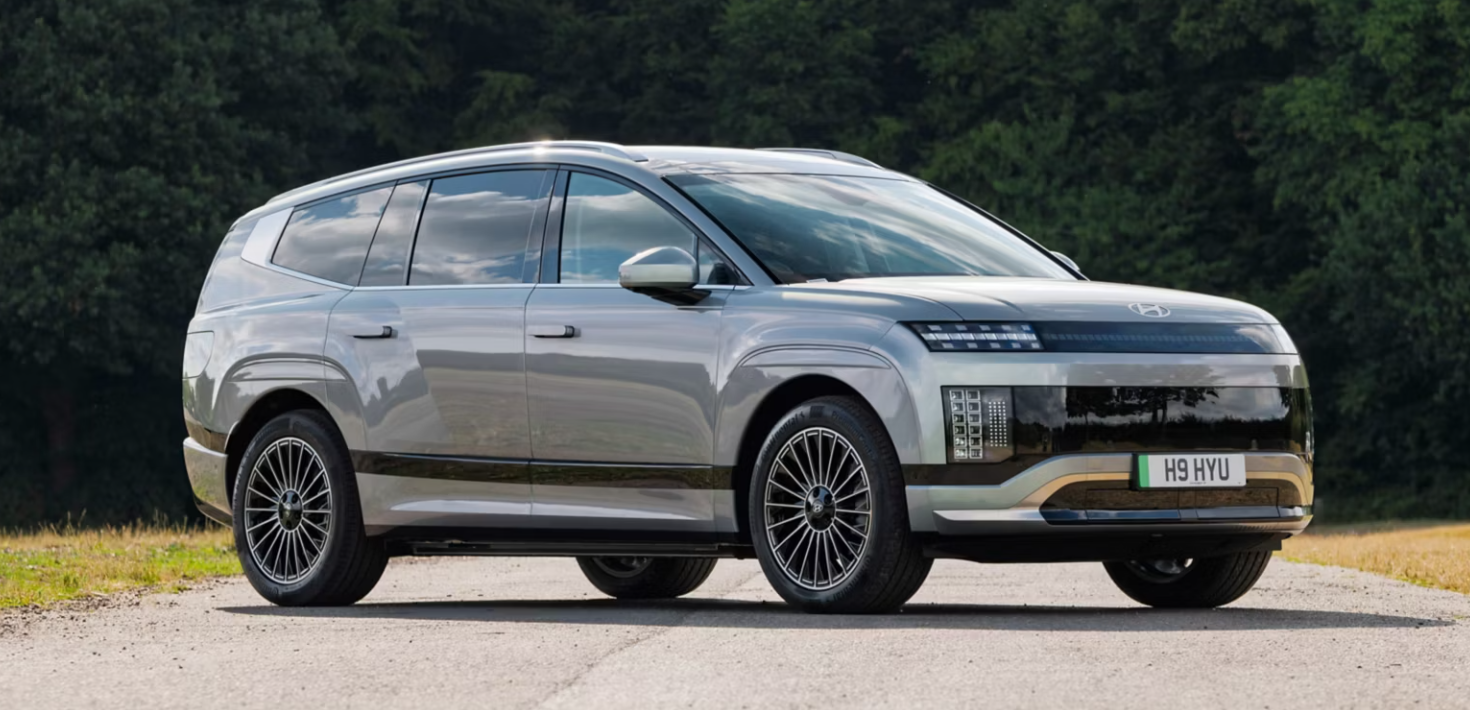
With one foot firmly planted in ICE vehicles and the other cautiously stepping into electrification, Laxmi Intercontinental Pvt. Ltd., the authorized distributor of Hyundai cars in Nepal, now appears ready to elevate its electric image with the IONIQ 9.
Like the IONIQ 5, the IONIQ 9 is electric from the ground up, built on Hyundai Motor Group’s dedicated Electric-Global Modular Platform (E-GMP). While the design philosophy is similar to that of its younger sibling, the 7-seater design, naming, and overall positioning might feel familiar to another EV.

That’s because the IONIQ 9 shares its core architecture with the Kia EV9, which is already available in the Nepali market. However, the IONIQ 9 is larger, offers more interior space, and presents a more premium take on the shared E-GMP platform. This shared DNA is no surprise, given Hyundai Motor Group’s controlling stake in Kia.
What is the Price of Hyundai IONIQ 9 in Nepal?
The Hyundai IONIQ 9 is offered globally in three powertrain configurations: two All-Wheel Drive (AWD) variants and a single Rear-Wheel Drive (RWD) option. For the Nepali market, Hyundai has confirmed the base RWD Long Range as the sole variant.
The IONIQ 9 is listed on Hyundai Nepal’s official website, though its price is still marked as “Upon Request.” Nevertheless, the official on-road price has already surfaced through several auto enthusiasts and reviewers.
The Hyundai IONIQ 9 price in Nepal is Rs. 2.20 Crores, making it one of the most expensive electric vehicles in the country.
From an accessibility standpoint, the IONIQ 9 further widens Hyundai Nepal’s current EV gap. But from a brand and market perspective, that may be exactly the point. The IONIQ 9 acts as a halo product, which is meant to reshape perception rather than sales charts. It reflects how Nepal’s maturing EV landscape could encourage distributors to move beyond accessible compact SUVs and bring more premium models as infrastructure and consumer confidence continue to improve.
By committing to bringing a full-size, high-end electric SUV like the IONIQ 9 to Nepal, Hyundai is effectively throwing down the gauntlet. It is betting that the market is ready, or at least close to ready, for EVs that prioritize scale, sophistication, and presence over affordability alone. Whether that bet pays off remains to be seen.

Now, let’s have a look at the key specifications of the Hyundai IONIQ 9 in Nepal for 2026.
Hyundai IONIQ 9 Specifications
- Motor & Drivetrain:
- Motor: 160 kW PMSM
- Max Power: 218 PS
- Max Torque: 350 Nm
- Transmission: Single-Speed Automatic
- Drive Type: Rear Wheel Drive
- 0 to 100 km/h: 9.4 seconds
- Top Speed: 190 kmph
- Dimensions & Chassis:
- Dimensions: 5060 (L) x 1980 (W) x 1790 (H) mm
- Wheelbase: 3130 mm
- Kerb Weight: 2,470 – 2,612 kg
- Roof Rack Load: 100 kg
- Ground Clearance: 174 mm
- Suspension: McPherson Strut and Multi-Link system
- Seating Capacity: 7 (Three Rows)
- Battery & Energy
- Battery Type: NCM (Nickel-Cobalt-Manganese)
- Battery Capacity: 110.3 kWh
- Driving Range: 620 km (WLTP)
- Electrical Architecture: 800V
- Charging Time:
- AC Charging: 0 to 100% in around 10 hours with an 11 kW AC Charger
- DC Charging:
- 10% to 80% in around 109 minutes with a 50 kW Charger
- 10% to 80% in around 24 minutes with a 350 kW Charger
- Charging Standard: CCS Type 2
- Vehicle-to-Load (V2L): Yes
- Wheels & Tyres
- Wheel Size: 20-inch Alloy
- Tyres: 275/50 R20
- Tubeless Tyres: Yes
- Storage Capacity: 338 litres (expandable up to 2,419 litres)
- Safety System: 5-Star ANCAP/EuroNCAP, 10 Airbags, ADAS, 360 Degree Camera
Hyundai IONIQ 9 Price in Nepal: Rs. 2,20,00,000 (RWD Long Range)
ALSO READ: Hyundai IONIQ 5 Price in Nepal (October 2026 Updated)
Hyundai IONIQ 9 Overview
Exterior
There’s nothing ordinary about the IONIQ 9. Its massive proportions and futuristic styling give it an unmistakable road presence. The Hyundai IONIQ 9 follows Hyundai’s “Aerosthetic” design philosophy, which is a lexical blend of aerodynamics and aesthetics. This approach traces its roots directly to the Hyundai Seven Concept, carrying forward elements like parametric pixel lighting and a lounge-inspired cabin into a production-ready, three-row electric SUV built on the E-GMP platform.
At the front, the IONIQ 9 makes a strong first impression with its bold horizontal Parametric Pixel LED daytime running lights that stretch across the width of the vehicle. These are formed by a dense array of individual lighting elements and are complemented by low-mounted, side-positioned LED projection headlamps. Hyundai has eliminated the traditional grille, replacing it with a smooth gloss-black panel that incorporates subtle air channels for battery cooling, giving the front end a clean appearance.
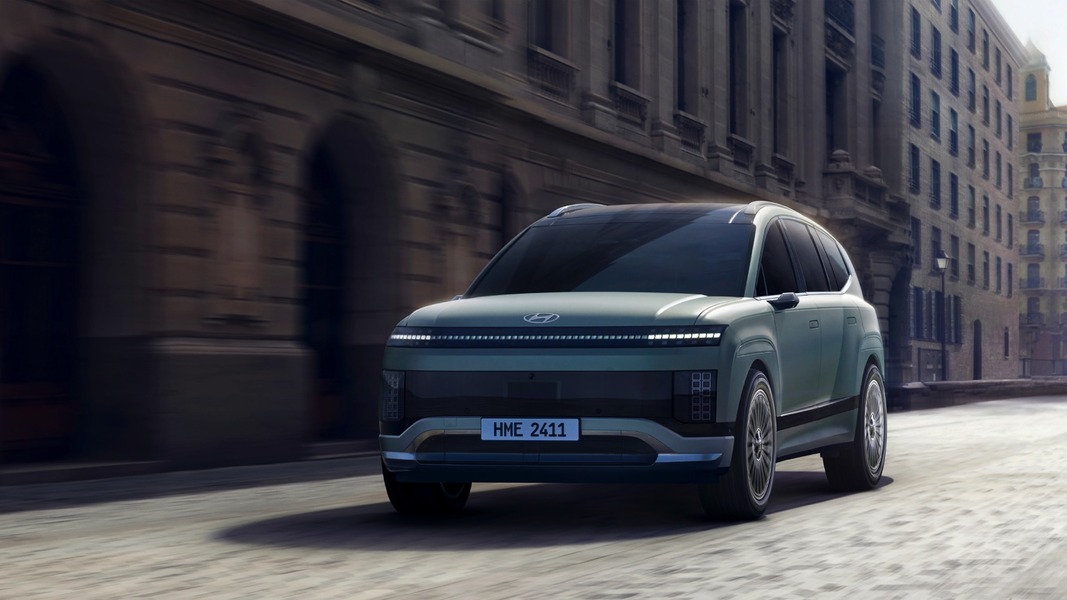
This treatment supports Hyundai’s “Aerosthetic” design by reducing drag and smoothing airflow. However, the large gloss-black panel is prone to showing scratches and dust, and repairs after a frontal impact can be costly.
Moving on, the front bumper integrates a lower splitter with active air flaps. These flaps open and close depending on cooling demand, helping manage battery and motor temperatures while also improving aerodynamic efficiency when cooling requirements are low.
From the side, the IONIQ 9 is the most divisive. Striking does not necessarily mean conventionally attractive, and the profile definitely will not appeal to everyone. That said, there is solid engineering logic behind it. Designing a seven-seater electric SUV over 5 meters long is a complex challenge. Engineers must balance battery packaging, third-row usability, real-world range, and crash safety with structural rigidity. Improving one area often forces compromises in another.
Hyundai’s design team addressed this challenge in a fairly transparent way. Let’s start with the battery packaging. The E-GMP platform allows for a flat-floor battery layout, which maximizes interior volume. This shows clearly in the side profile, where the lower body remains level without visible steps or protrusions, and that flat lower section directly contributes to better cabin space and easier ingress.
Third-row usability drives the second major design decision, and this is what contributes to the polarizing side view. Hyundai clearly prioritized comfort and space over sleek proportions. The rear half of the vehicle looks long and peculiar because it needs to accommodate adults in the third row rather than treating those seats as occasional or child-only.
ALSO READ: Hyundai Creta Electric Price in Nepal (October 2026 Updated)
The third design priority is driving range. The gently sloping roofline, flush pop-out door handles, combined with a subtle boat-tail rear, helps manage airflow cleanly. Even with conventional side mirrors, the IONIQ 9 achieves a drag coefficient of just 0.269 Cd, an impressive figure for a three-row electric SUV. This directly contributes to its ability to deliver over 500 km of real-world driving range.
Crash safety and structural rigidity form the fourth pillar. A long wheelbase and a heavy underfloor battery require strong side structures and reinforced pillars. Thicker doors, higher shoulder lines, and broader pillars may have added visual bulk, but they also help the vehicle meet global safety standards like the ANCAP and Euro NCAP and protect occupants across all three rows.
The IONIQ 9 rides on 20-inch multi-spoke alloy wheels wrapped in 275/50 R20 tyres, while the clever wheel arch styling helps disguise its bulk and gives the SUV a more planted stance on the road.
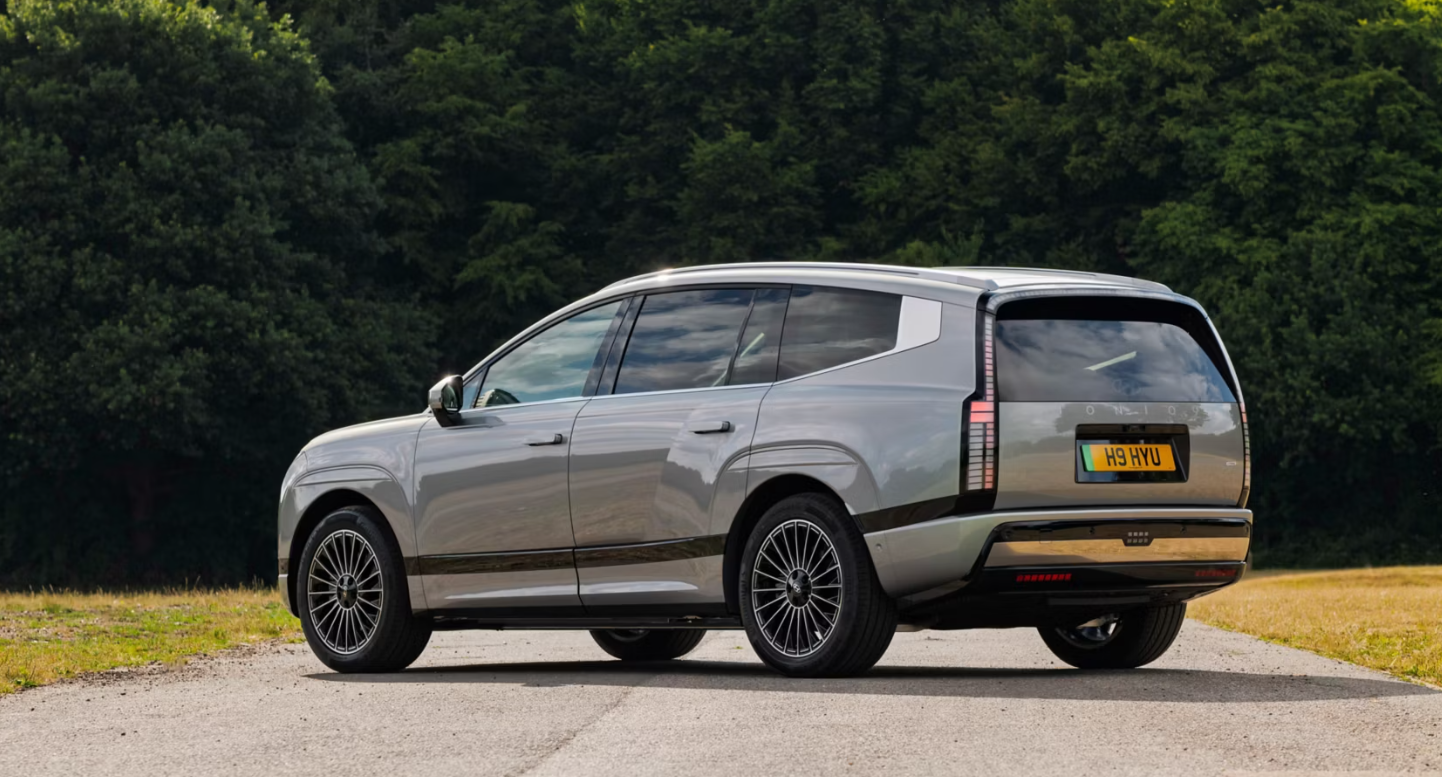
At the rear, Hyundai continues the pixel theme with a full arc of lighting that stretches from the bumper up toward the roof. The U-shaped taillight signature looks distinctive at night and features dynamic lighting for braking and signaling. In daylight, however, the rear can appear slab-sided and lacks sculpted depth. One practical highlight is the height-adjustable powered tailgate, which allows users to set an opening height suitable for low ceilings or tight parking spaces.
All in all, the exterior design of the IONIQ 9 makes sense once you understand the priorities behind it. Some buyers will appreciate the aerodynamic efficiency and the way it stands out in a crowded EV market. Others may find it too van-like in silhouette and feel it won’t win any beauty contests, but as a thoughtfully engineered large electric SUV, the IONIQ 9’s case remains defensible.
Interior
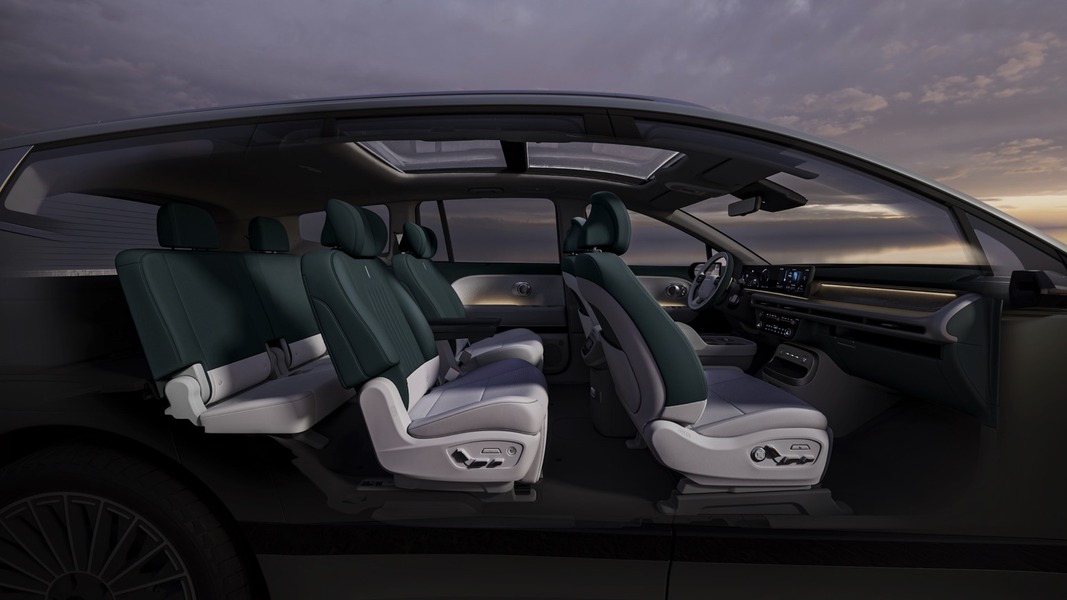
Step inside, and the IONIQ 9 feels more like a lounge than a conventional SUV cabin. It has a three-row, seven-seat layout with a “library-quiet” ambiance, achieved through multilayer sound insulation and active road-noise cancellation. All around the touch points and rest areas, you’d find a good wrapping of soft-touch materials, which gives the feeling of premiumness.
The seats come in a sort of dual-tone finish and are wrapped in H-Tex faux leather. The seats offer a wide range of comfort features. The driver’s seat features a massage function, while both front seats come with 8-way electrical adjustability, 4-way lumbar support, built-in leg rests with recline function, ventilation, and heating. In addition, you also get the memory function for the seat, steering wheel, and outside mirrors.
The front passenger seat gets a Walk-in Device, enabling second-row passengers to electrically adjust it for easier third-row access and added convenience.
The second row seats, however, feature a manual lever for position adjustment, but it does feature heating, ventilation, and separate climate control apart from the front one, which can be adjusted through the dedicated control panel at the console pillar.
The third row seats, however, do not feature any of those features. But as we discussed before, they are spacious enough to sit three full adults, and that’s how you make a 7-seater configuration car.
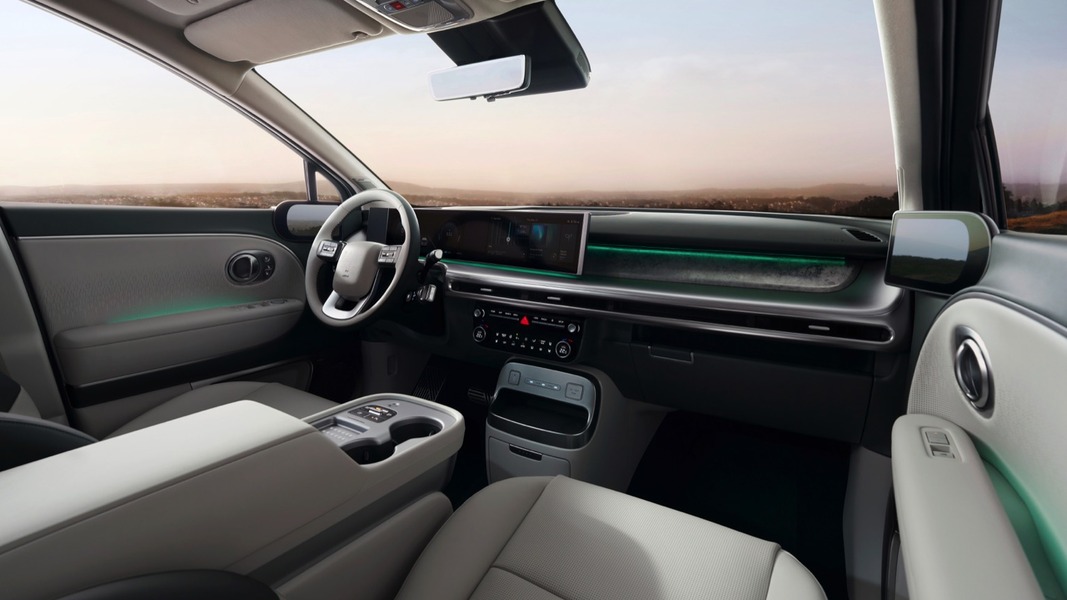
At the front, the driver sits behind dual curved 12.3-inch screens that serve as infotainment and instrument cluster. A head-up display also helps keep key driving information in the driver’s line of sight. The steering wheel features power adjustability for height and position, and yes, the steering wheel does feature mounted controls.
Thankfully, Hyundai has retained physical controls on and around the center console for frequently used functions, making everyday operation straightforward. Practicality is another strength, with generous storage throughout the cabin, including the center console, glove box, and door pockets.
Other amenities include multiple 100W USB-C charging ports across all three rows, roof-mounted AC vents, a 3.6 kW Vehicle-to-Load (V2L) system, a 14-speaker BOSE sound system, a wireless charging pad, an opening panoramic sunroof, wireless Apple CarPlay and Android Auto, ambient interior lighting, and more.
Performance
The IONIQ 9 isn’t about outright performance. Instead, it focuses on refinement. Its 160 kW Permanent Magnet Synchronous Motor delivers 218 PS of power and 350 Nm of torque, enabling a 0–100 km/h sprint in 9.4 seconds and a 190 km/h top speed. Those figures are perfectly respectable for a 2.5-tonne three-row electric SUV.
More importantly, Hyundai’s E-GMP platform ensures smooth, linear power delivery with consistent pedal response, while the Rear-Wheel Drive (RWD) setup provides a composed and balanced driving character. The IONIQ 9 also gets AI-powered Auto Terrain Mode and Terrain Traction Control, allowing it to automatically optimize traction and driving characteristics across different road surfaces.
A significant portion of that weight comes from its massive 110.3 kWh battery pack. Based on the Nickel-Cobalt-Manganese (NCM) lithium-ion chemistry, it supports a WLTP range of 620 km, while the EPA estimates it to be around 540 km. In real-world conditions, achieving over 500 km on a single charge is entirely possible, allowing you to cover most of Nepal’s long highway stretches without worrying about frequent recharging.
The most significant technical advantage the IONIQ 9 holds over most of its rivals in Nepal is its 800-volt electrical architecture. This allows the battery to accept higher charging rates with lower thermal stress than conventional 400V systems. Connected to a 350 kW DC fast charger, the IONIQ 9 can replenish from 10 to 80 percent in approximately 24 minutes.
At present, Nepal has no 350 kW chargers, but the vehicle is already prepared for future infrastructure growth. On a standard Level 2 AC home charger, however, the large 110.3 kWh battery will take considerably longer, so buyers who rely mainly on overnight charging should plan accordingly.
Additional Details
Suspension duties are handled by a MacPherson strut front and multi-link rear setup, featuring self-leveling dampers and hydro-bushings for a plush ride and improved stability under load.
The IONIQ 9 measures 5060 mm in length, 1980 mm in width, and 1790 mm in height, while its generous 3130 mm wheelbase ensures excellent interior space. It offers 174 mm of ground clearance, which should be sufficient for most paved roads, though it may reduce slightly under a full passenger load on rougher sections.
The storage includes an 88-liter frunk space and 338 liters of boot space. The space can be expanded up to 908 liters if you fold the 3rd row seats, and further up to a massive 2419 liters if both the 2nd and 3rd row seats are folded.
Safety is well covered with 10 airbags and Hyundai SmartSense, the brand’s advanced driver assistance suite that includes adaptive cruise control, lane-keeping assist, autonomous emergency braking, Blind-Spot View Monitor, and an in-cabin camera. It also gets a 360-degree Surround View Monitor and Remote Smart Parking Assist 2, both particularly useful for a large SUV on Nepal’s narrow roads and in tight parking spaces. The IONIQ 9 also gets third-row seatbelt pretensioners and load limiters, a thoughtful safety feature that remains uncommon even among large SUVs.
Hyundai IONIQ 9 Features List
Exterior:
- Parametric Pixel LED DRL & Positioning Lamps
- Small Cube LED Projection Headlamps
- 20-inch Alloy Wheels
- Windscreen Auto Defog and Heated Rear Window
- Openable Panoramic Sunroof
- Power Tailgate (height adjustable)
- Boat-tail Inspired Design
Interior:
- Panoramic Curved Display (12.3″ cluster + 12.3″ touchscreen)
- Automatic Climate Control with Independent Automatic Temperature Control (2nd-row)
- Heated and Ventilated 1st and 2nd-row Seats
- Powered 3rd-row Seats (folding/reclining)
- Full-flat Folding Seats (2nd & 3rd row)
- Head-up Display
- Bose Premium Sound System (14 speakers)
- 100W USB-C ports (all rows)
- Vehicle-to-Load (V2L) Indoor & Outdoor
Safety:
- 5-Star ANCAP and Euro NCAP Rating
- 10 Airbags
- ADAS Suite
- 360 Degree Camera
- Blind-Spot View Monitor
- Remote Smart Parking Assist 2
- In-cabin Camera
Hyundai IONIQ 9 Price in Nepal and Availability
When it comes to pricing, the Hyundai IONIQ 9 price in Nepal is set at Rs. 2.2 Crores, making it one of the most expensive and premium electric vehicles available in the country.
The pricing becomes easier to justify when you consider its seven-seat layout, 110.3 kWh battery pack, and flagship positioning within Hyundai’s global EV lineup. With the IONIQ 5 already priced well above the Rs. 1 crore mark, the IONIQ 9’s premium positioning comes as little surprise.
| Hyundai IONIQ 9 Variant | Price in Nepal |
|---|---|
| RWD Long Range | Rs. 22000000 |
Rivals
When it comes to rivals, the comparison is obvious. The Kia EV9 and Hyundai IONIQ 9 are both Korean-made, seven-seat flagship EVs built on the same E-GMP platform, targeting buyers looking for a large, premium electric family SUV.
In terms of performance, both are nearly identical, producing 218 PS of power and 350 Nm of torque. Despite being larger and heavier, the IONIQ 9 keeps pace with the lighter EV9 thanks to its more aerodynamic design. However, the biggest difference lies in the battery. The IONIQ 9’s 110.3 kWh battery significantly outclasses the EV9’s 76 kWh unit, translating to a real-world range of well beyond 500 km, while the EV9 typically delivers around 400–450 km.
In addition, the IONIQ 9 offers a roomier cabin and stronger road presence, while the EV9 stands out with its sharper design. Inside, the IONIQ 9 takes the lead with a more premium feel and advanced features.
For buyers who frequently use all three rows and prioritize maximum range and faster charging, the IONIQ 9 makes a compelling case. Those who only need the third row occasionally and want a flagship three-row EV at a lower price point may find the EV9 to be the more accessible choice.
The IONIQ 9 represents Hyundai’s push into Nepal’s premium EV segment, combining luxury, space, and technology. Backed by Hyundai’s strong reputation and the IONIQ 5’s positive market reception, it makes a strong case for buyers seeking a premium three-row electric SUV. Ultimately, the IONIQ 9’s future in Nepal will depend on whether there is enough demand for high-end electric SUVs at this price level.
What do you think about the Hyundai IONIQ 9? Can it carve out a place in Nepal’s niche seven-seater EV segment? Let us know in the comments below.
Frequently Asked Questions
What is the price of Hyundai IONIQ 9 in Nepal?
The Hyundai IONIQ 9 price in Nepal is Rs. 2,20,00,000 for the RWD Long Range variant.
Who is the authorized distributor of Hyundai IONIQ 9 in Nepal?
Laxmi Intercontinental Pvt. Ltd. is the authorized distributor of Hyundai vehicles, including the IONIQ 9, in Nepal.
How many seats does the Hyundai IONIQ 9 have?
The Hyundai IONIQ 9 is a three-row, seven-seater electric SUV.
What is the battery capacity of the Hyundai IONIQ 9?
The IONIQ 9 packs a 110.3 kWh battery with a claimed WLTP range of up to 620 km.
How fast does the Hyundai IONIQ 9 charge?
The IONIQ 9’s 800V electrical architecture enables up to 350 kW DC fast charging, taking the battery from 10% to 80% in around 24 minutes.
-
Samsung Galaxy A08 Coming Soon in Nepal With A Few UpgradesHIGHLIGHTS The Samsung Galaxy A08 price in Nepal could start at Rs. 35,499 (4/64GB). It…

-
Samsung Galaxy A07s Silently Launched in Nepal: What Does the ‘s’ Actually Add?HIGHLIGHTS The Samsung Galaxy A07s price in Nepal is Rs. 30,499 (4/64GB). It is powered…
-
realme 16 5G Pre-Booking Opens in Nepal: Spec Sheet Raises QuestionsHIGHLIGHTS The realme 16 price in Nepal is expected to start at Rs. 65,999 for…