

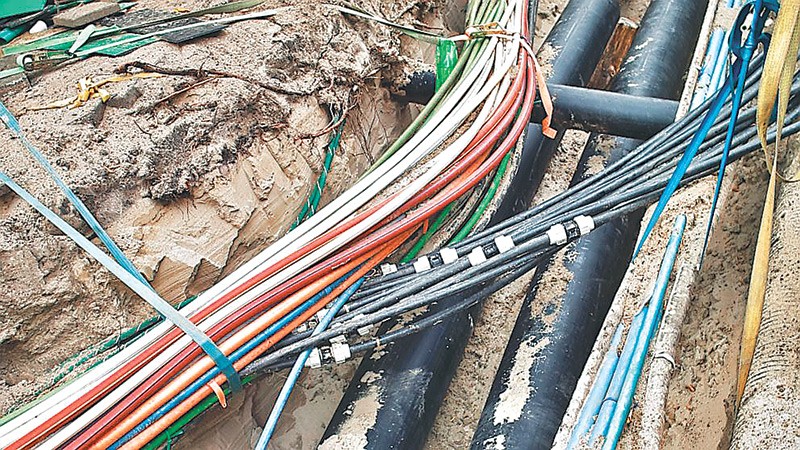
With an aim to reduce air-pollution that is prevalent in the country, Nepal Electricity Authority is to lay its cables underground using a method called “Horizontal Directional Drilling (HDD)”. This method does not require digging and damaging the road surface which in turn prevents air pollution. This method is being used in Nepal for the first time.
“A small pilot hole will be dug at a distance of every 200 metres, and a drill pipe will grind the soil up to the next hole,” said Manoj Silwal, chief of the Project Management Directorate at the NEA.
He adds that the holes will be blacktopped instantly.

Silwal said that in the first phase, the cables would be sent underground at the major thoroughfares in the Kathmandu Valley.
The state-owned electricity monopoly is installing underground electricity cables of about 200 kilometres in length in parts of the Kathmandu Valley that come under its Maharajgunj and Ratnapark Distribution Centres.

Along with the electricity cables, fiber optics cable are to be laid simultaneously as well.
This time, there is going to be great relief for the Department of Roads (DoR), a government agency with the responsibility of constructing and maintaining the major roads.
Joint spokesperson at the DoR Ramesh Kumar Singh said that there used to be a problem every time a water pipeline, telecom cable or sewerage pipe was laid as the construction always damaged the roads. But applying the new technology while laying the electricity cables will not demand any action from the DoR.
The US $50 million project also includes distribution automation, said Silwal.
The project is supposed to be completed in two-and-a-half years.
-
Realme P4 Power Arrives in Nepal — A Bit Too Late?HIGHLIGHTS The realme P4 Power price in Nepal is Rs. 76,999 (12/256GB). It has a…

-
MASSIVE PRICE HIKE!!! Infinix Note 60 Series Got Expensive By Up to Rs. 9,000HIGHLIGHTS The Infinix Note 60 Series prices in Nepal start at Rs. 54,999 (8/128GB –…
-
Infinix Note Edge Gets Expensive: But Starting Price Remains UnchangedHIGHLIGHTS The Infinix Note Edge price in Nepal starts at Rs. 41,999 (6/128GB). The MediaTek…